From Parts to Standards: The Four Stages of China’s Auto Globalization
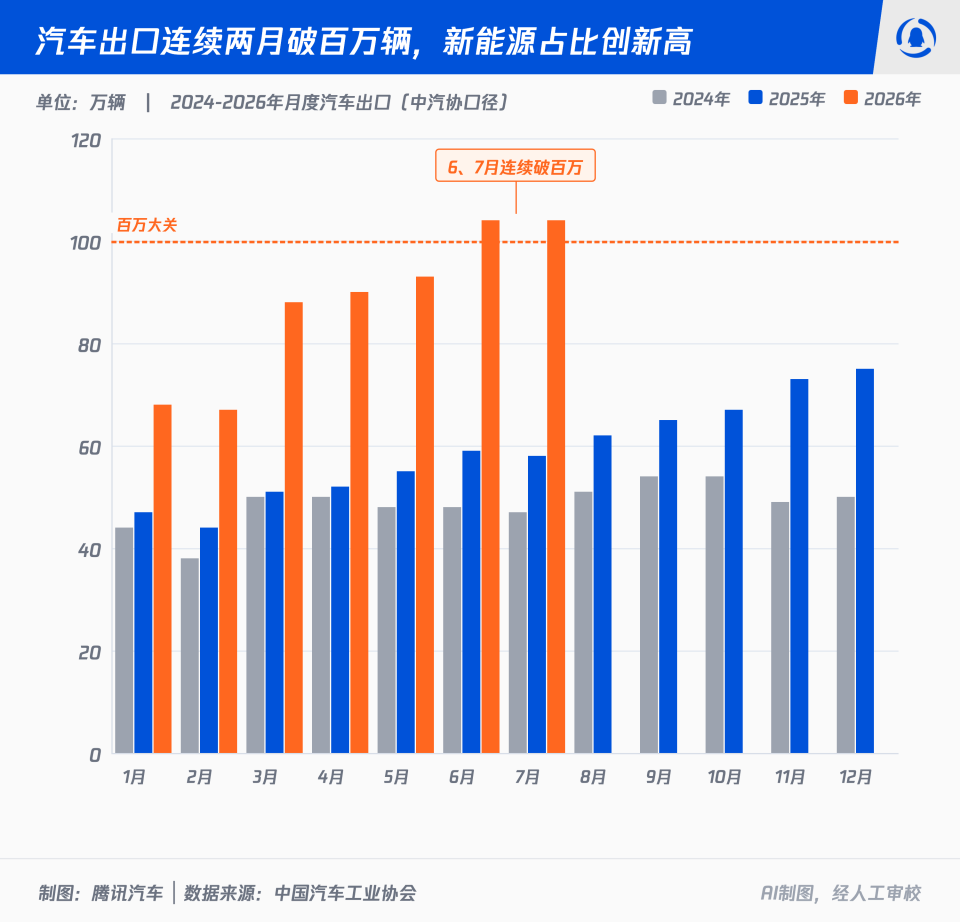
On August 18, the China Association of Automobile Manufacturers (CAAM) reported that China exported 1.043 million vehicles in July, up 81.3% year on year. New energy vehicles accounted for 53% of exports. In the first seven months of 2026, China exported 6.14 million vehicles, up 66.8%, putting the country on track to surpass 10 million exports for the year.
But the real story is not simply about rising sales. China’s auto industry is moving from exporting parts and products to exporting technology and, increasingly, helping shape global standards.
01 Parts: From “Alternative” to “Essential”
China’s automotive globalization began with auto parts.
In the early 1990s, localization policies opened a door that had long been closed by multinational automakers. Fuyao Glass, for example, won an Audi 100 localization order in 1992 and entered Audi’s global procurement system 13 years later.
CATL took a faster route. Founded in 2011, it completed a major BMW-related project in 2012 by meeting hundreds of pages of German technical standards. It later expanded into global supply chains serving Mercedes-Benz, Volkswagen, Toyota, Tesla and others.
Today, Chinese companies account for 20 of the world’s top 100 automotive suppliers. Their products cover batteries, chassis components, automotive electronics, thermal management, and vehicle interiors.
The problem is that cost alone is no longer enough. Rising labor costs, raw-material prices, weak consumer brand recognition, and increasingly strict environmental and regulatory requirements are putting pressure on Chinese suppliers.
Parts companies can enter global supply chains, but to move further, they need the momentum and scale of Chinese automakers going overseas.
02 Brands: From “Selling Abroad” to “Putting Down Roots”
Chinese brands are rapidly gaining ground in Europe. Their market share has continued to rise, but exporting cars is only the beginning.
Tariffs, logistics, certification, and compliance costs make it difficult to rely on exports alone. Chinese automakers are therefore accelerating localization through factories, supply chains, dealerships, and after-sales networks.
BYD is building a plant in Hungary; Chery has taken over a former Nissan factory in Spain; XPeng is working with Magna in Austria; and Leapmotor is producing vehicles with Stellantis in Spain.
The goal is to move from “selling cars in Europe” to “building cars in Europe.”
The biggest challenge is not price but trust. European consumers already have mature preferences and long-established relationships with local brands and dealers. Leasing, fleet purchases, insurance, maintenance, and residual values also play major roles in buying decisions.
This means Chinese brands must build complete local ecosystems, not just competitive products.
Going global is ultimately a shift from selling a car to building trust.
03 Technology: The Flow Is Reversing
The electric and intelligent-vehicle era is changing the competitive landscape.
In the age of internal-combustion engines, European suppliers dominated key technologies such as engines, transmissions, and chassis systems. Today, software, algorithms, computing power, intelligent driving, and smart cockpits are becoming equally important.
China has a major advantage: the world’s largest new-energy vehicle market, huge amounts of real-world data, and extremely fast product iteration.
As a result, Chinese technology providers are increasingly working with global automakers. Examples include Momenta’s partnerships with BMW, Mercedes-Benz and Audi, ECARX’s cooperation with Volkswagen, and CATL’s expansion of battery-swapping technology into Europe.
The direction of technology transfer is changing: China is no longer only learning from Europe; it is increasingly exporting platforms, architectures, and solutions to global markets.
Yet technology cooperation also touches industrial sovereignty. Overseas automakers may need Chinese technology while remaining cautious about openly adopting it. The next challenge is therefore not just technological competitiveness, but integration into local industrial ecosystems.
04 Standards: From Rule-Follower to Rule-Maker
The highest level of influence lies in standards.
For years, Chinese automakers largely followed international frameworks developed by organizations such as ISO, IEC and UNECE. That is beginning to change.
In July 2026, China played a key role in the United Nations’ global technical regulation for automated driving systems, participating as vice-chair and co-chair and submitting numerous technical proposals.
This reflects a broader shift: China is moving from following standards to participating in the creation of standards.
Standards are not defined only on paper. They are also shaped by actual market adoption. Tesla’s NACS charging system is a good example: large-scale adoption eventually made it influential far beyond its original specification.
The same logic could apply to intelligent driving, battery swapping, charging, and other technologies developed at scale in China.
Emerging markets in Southeast Asia, the Middle East, Latin America, and Africa may offer even greater opportunities because many are still developing their own automotive standards and infrastructure.
At the same time, success in mature markets requires dialogue, compliance, and mutual recognition.
Real influence comes when a company’s technology is not only accepted by the market, but also reflected in the rules that govern the market.
Conclusion: The Journey Continues
Parts, brands, technology, and standards are not separate stages. They overlap and reinforce one another.
Parts exports built China’s manufacturing capabilities. Overseas brands created global market experience. Technology exports expanded China’s influence. And participation in international standards is opening the door to a higher level of global influence.
China’s auto industry has come a long way, but the journey is far from over.